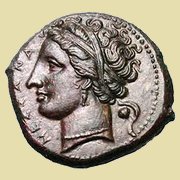
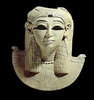
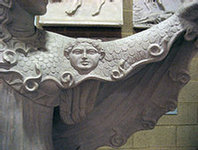
An aegis is a large collar or cape worn in ancient times to display the protection provided by a high religious authority or the holder of a protective shield signifying the same.
The aegis, as stated in the Iliad, is the shield or buckler of Athena or Zeus, which according to Homer was fashioned by Hephaestus. "...and among them went bright-eyed Athene, holding the precious aegis which is ageless and immortal: a hundred tassels of pure gold hang fluttering from it, tight-woven each of them, and each the worth of a hundred oxen."
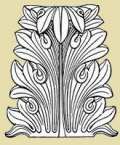
Acanthus
The acanthus is one of the most common plant forms followed, not necessarily very closely, to make foliage ornament and decoration.
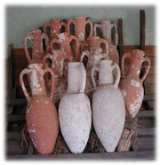
Amphora
An amphora (plural: amphorae or amphoras) is a type of vase-shaped, usually ceramic container with two handles and a long neck narrower than the body. The word amphora is Latin, derived from the Greek amphoreus, an abbreviation of amphiphoreus, a compound word combining amphi- ("on both sides", "twain") plus phoreus ("carrier"), from pherein ("to carry"), referring to the vessel's two carrying handles on opposite sides.
Animals
Bee - Symbol of Demeter. In addition, priestesses worshipping Artemis and Demeter were called "Bees" and the Delphic priestess is often referred to as a bee.
Boar - Sacred to Ares.
Bull - Reference to Dionysos.
Cock - Symbol of vigilance.
Dog - Usually associated with Artemis the Huntress.
Dolphin - Associated with Poseidon. (See separate entry for Dolphin).
Dove - Symbolizing the renewal of life.
Eagle - An attribute of Zeus.
Fish - Possibly associated with Aphrodite.
Horse - Boreas (North Wind) in the form of a stallion fathered 12 colts.
Owl - An attribute of Athens.
Stag - Attribute of Artemis, goddess of the hunt.
Stork - In Greek mythology, Gerana was an Aethiope, the enemy of Hera, who changed her into a stork, a punishment Hera also inflicted on Antigone, daughter of Laomedon of Troy.
Most references courtesy of Wayne G. Sayles - Ancient Coin Collecting II.
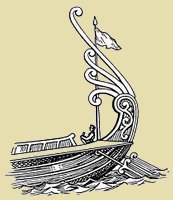
Aphlaston
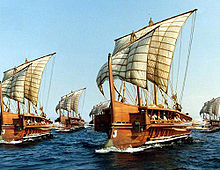
Aphlaston or Aplustre (alternate spelling apluster), an ornamental appendage of wood at the ship's stern, usually spreading like a fan and curved like a bird's feather.
The apluster is used on ancient coins to symbolize maritime power.
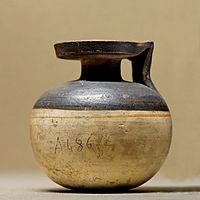
Aryballos
An aryballos was a small spherical or globular flask with a narrow neck used in Ancient Greece. It was used to contain perfume or oil, and is often depicted in vase paintings as being used by athletes bathing. In these depictions, the vessel is sometimes attached by a strap to the athlete's wrist, or is hung by this strap from a peg on the wall.
Astragalos
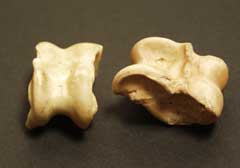
Knucklebones also known as hucklebones, dibs, dibstones, jackstones, chuckstones or five-stones, is a game of very ancient origin, played with five small objects, originally the "knucklebones" (actually the astragalus: a bone in the ankle, or hock of a sheep), which are thrown up and caught in various ways.
Bow
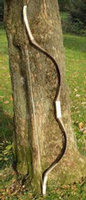
A bow is a weapon that projects arrows by its elasticity. Essentially, it is a form of spring. As the bow is drawn, energy is stored in the limbs of the bow and transformed into rapid motion when the string is released, with the string transferring this force to the arrow. Bows are used for hunting, for sport and still occasionally for war.
Bucranium
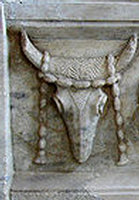
Bucranium (plural bucrania) is the Greek word for the skull of an ox. The bucranium is often decorated with fillets (ribbons)
as shown in this example.
It is generally considered to be a reference to the practice of garlanding sacrificial oxen, the heads of which were primitively displayed on the walls of the temples.
Caduceus (kerukeion)
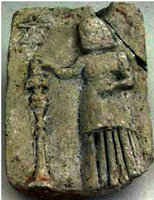
The caduceus is the staff carried by Hermes in Greek mythology. It is a short staff entwined by two serpents, sometimes surmounted by wings.
The term kerukeion denoted any herald's staff, not necessarily associated with Hermes in particular.
Chimera
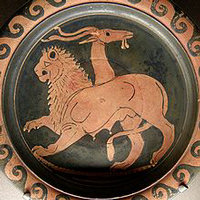
The Chimera or Chimaera was, according to Greek mythology, a monstrous fire-breathing female creature of Lycia in Asia Minor, composed of the parts of multiple animals: upon the body of a lioness with a tail that ended in a snake's head, the head of a goat arose on her back at the center of her spine.
Cippus
A small, low pillar, square or round, commonly having an inscription, used by the ancients for various purposes, as for indicating the distances of places, for a landmark, for sepulchral inscriptions, etc.
Club
An attribute of Herakles (Hercules) associated with several of his 12 labors.
It also serves as heraldic device for the Kings of Macedon who claimed to be descended from Herakles.
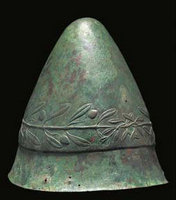
Conical Helmet
Helmet of conical form having a ridge above the broad brim, decorated in relief with a finely detailed berried olive wreath, the helmet pierced with holes for attachments.
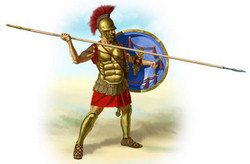
Corinthian Helmet
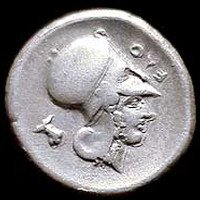
The Corinthian helmet originated in ancient Greece and took its name from the city-state of Corinth. It was a helmet made of bronze which, in its later styles, covered the entire head and neck with slits for the eyes and mouth. A large curved projection protected the nape of the neck. Out of combat, a Greek hoplite (citizen-soldier of the Ancient Greek city-states) would wear the helmet tipped upward for comfort (as does Athena on these staters).
Cornucopia
The cornucopia (Latin: Cornu Copiae) is a symbol of food and abundance dating back to the 5th century BC, also referred to as the food of worship and holiness, Horn of Amalthea, harvest cone, and horn of plenty.
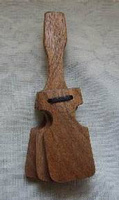
Crotalus
The Latin term for this Lenten wooden clapper is "Crotalus" which originated from the Greek word "krotalon" (κροταλον) which means "rattle" or "castanet".
The word crotalus, in modern day usage, refers to the genus of pit vipers or rattlesnakes found in the Americas. Also, the modern day castanet, (Spanish hand-held musical instrument), originated from the Crotalus.
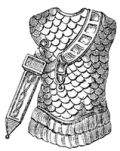
Cuirass
A Cuirass (French cuirasse, Latin coriaceus, made of leather, from corium, the original breastplate being of leather, pronounced in English as "kwi-rass"), is a piece of armour, formed of a single or multiple pieces of metal or other rigid material, which covers the front of the wearer's person.
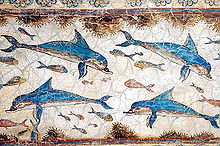
Dolphins
Dolphins are marine mammals that are closely related to whales and porpoises.
Dolphins have long played a role in human culture. Dolphins are common in Greek mythology and there are many coins from ancient Greece which feature a man or boy or deity riding on the back of a dolphin. The Ancient Greeks welcomed dolphins; spotting dolphins riding in a ship's wake was considered a good omen.
Dolphins are closely associated with Poseidon.
Fresco of Dolphins, ca. 1600 BC, from Knossos, Crete.
Eagles
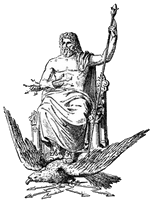
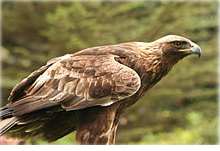
The eagle is the patron animal of Zeus. In particular, Zeus was said to have taken the form of an eagle in order to abduct Ganymede, and there are numerous artistic depictions of the Eagle Zeus bearing the hero Ganymede aloft.
According to some ancient tales, Zeus took the form of an eagle, to Ganymede for service as cup-bearer on Olympus.
Fillet
A ribbon or band used for decoration or to bind hair. Often used to decorate cornucopia, thyrsos, caduceus and items carried by Nike. Also used to decorate a bucranium .
Can also sometimes refer to taenia which is a decorative headdress in Latin.
Gods & Goddesses
Apollo has been variously recognized as a god of light and the sun; truth and prophecy; medicine, healing, and plague; music, poetry, and the arts; and more.
Ares was the Greek god of war.
Athena Promachos was a colossal bronze statue of Athena which stood on the Acropolis of Athens.
Demeter was the goddess of the harvest, who presided over grains, the fertility of the earth, and the seasons.
Dionysos was the god of the grape harvest, winemaking and wine, of ritual madness and ecstasy.
Helios - In Greek mythology, the sun was personified as Helios.
Nike - Nike was a goddess who personified victory, also known as the Winged Goddess of Victory.
Silenus was a companion and tutor to the wine god Dionysus.
Triton is a mythological Greek god, the messenger of the sea. He is the son of Poseidon, god of the sea.
Zeus is the "Father of Gods and men", according to Hesiod's Theogony, who ruled the Olympians of Mount Olympus as a father ruled the family.
Gorytos
A container for bows and arrows. Also called Quiver
Gryphon (Griffon)
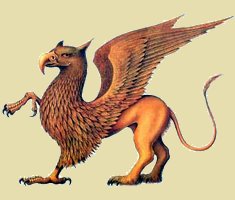
The griffin, griffon, or gryphon is a legendary creature with the body of a lion and the head and wings of an eagle.
Most statues have bird-like talons, although in some older illustrations griffins have a lion's forelimbs; they generally have a lion's hindquarters. Its eagle's head is conventionally given prominent ears; these are sometimes described as the lion's ears, but are often elongated (more like a horse's), and are sometimes feathered.
Harpa or Hook
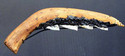
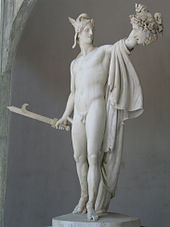
HARPA, a very ancient kind of instrument, in the form of a denticulated sickle, one of the symbols of Saturn who, according to a horrid myth, used it to mutilate his father, Uranus. Mercury is also said to have used a harpa to kill Argus, and Perseus employed it as a weapon to cut off the head of Medusa.
OR
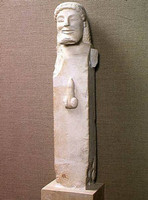
Herm
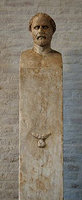
A Herma, commonly in English herm, is a sculpture with a head, and perhaps a torso, above a plain, usually squared lower section, on which male genitals may also be carved at the appropriate height.
The use of the herm is not unique to Greek coins, many Roman coins also depict this sculpture.
Hydria
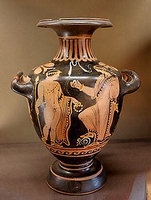
A hydria (plural hydriai) is a type of Greek pottery used for carrying water. The hydria has three handles. Two horizontal handles on either side of the body of the pot were used for lifting and carrying the pot. The third handle, a vertical one, located in the center of the other two handles, was used when pouring water. Also known as a Oenochoë.
Ithyphallic Herm
In traditional Greek mythology, Hermes, god of boundaries and exchange (popularly the messenger god), is considered to be a phallic deity by association with representations of him on herms (pillars) featuring a phallus. There is no scholarly consensus on this depiction and it would be speculation to consider Hermes a type of fertility god.
Javelin
The Greeks did not only use javelins on the field of war. The spear-like missiles were often used as an effective hunting weapon, the strap adding enough power to take down large game.
Javelins were also used in the Olympics, then known as The Crown Games. They were hurled in a certain direction and whoever hurled it the farthest, as long as it hit tip-first, won that game.
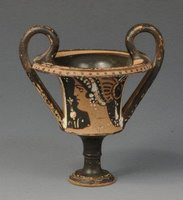
Kantharos
A kantharos or cantharus is a type of Greek pottery used for drinking. It is characterized by its high swung handles which extend above the lip of the pot.
The god Dionysus had a kantharos which was never empty!
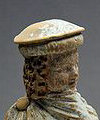
Kausia
A kausia was a flat Macedonian hat which was worn during the Hellenistic period but perhaps even before the time of Alexander the Great and was also used in lion hunting and as a protection against the sun by the poorer classes in Rome.
Ketos
In ancient Greek, the word ketos - Latinized as cetus - denotes a large fish, a whale, or a sea monster. The sea monsters slain by Perseus and Herakles were each referred to as a cetus by ancient sources. The term cetacean originates from cetus. In Greek art, cetea were depicted as serpentine fish. The name of the mythological figure Ceto is derived from ketos. The name of the constellation Cetus also derives from this word.
Kithara
The kithara or cithara was an ancient Greek musical instrument in the lyre or lyra family.
In modern Greek the word kithara has come to mean "guitar" (a word whose origins are found in kithara).
Krater
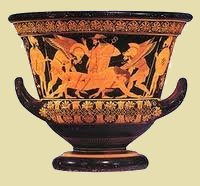
A krater was a large vase used to mix wine and water in Ancient Greece.
At Greek gatherings, kraters were placed in the center of the room. They were quite large, so they were not easily portable when filled. Thus, the wine-water mixture would be withdrawn from the krater with other vessels.
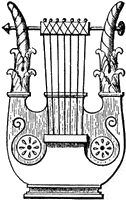
Lyre (kithara)
The lyre is a stringed musical instrument well known for its use in Greek classical antiquity and later. It is especially connected with the God Apollo.
The kithara is a variation on the basic lyre and appears on many coins of Lycia.
Modius
A tall cylindrical container which was also the largest Roman measure of capacity. In Classical art and Egyptology, the term is used also to describe a tall cylindrical head-dress with which certain gods are represented.
Nike
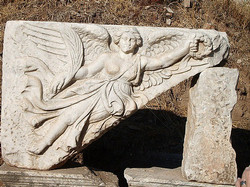
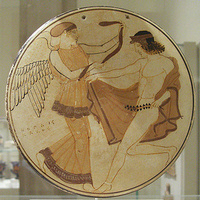
In Greek mythology, Nike was a goddess who personified victory, also known as the Winged Goddess of Victory.
Nike is the goddess of strength, speed and victory. Nike was a very close acquaintance of Athena, and is thought to have stood in Athena's outstretched hand in the statue of Athena located in the Parthenon. Nike is one of the most commonly portrayed figures on Greek coins. Image opposite is at Ephesus.
Omphalos
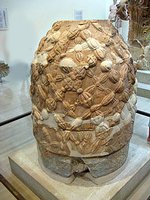
An omphalos is an ancient religious stone artifact, in Greek the word omphalos means "navel". According to the ancient Greeks, Zeus sent out two eagles to fly across the world to meet at its center, the "navel" of the world. Omphalos stones used to denote this point were erected in several areas surrounding the Mediterranean Sea; the most famous of those was at the oracle in Delphi. It is also the name of the stone given to Cronus in Zeus' place in Greek mythology.
Palmette
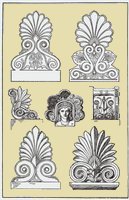
A palmette or anthemion (from the Greek for flower) is an artistic motif resembling the fan-shaped leaves of a palm tree.
Patera
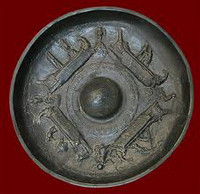
A patera was a broad, shallow dish used for drinking, primarily in a ritual context such as a libation. These paterae were often used in Rome.
They are described as umbilicated or ornate depending on the designs on them. This one is umbilicated.
Phiale
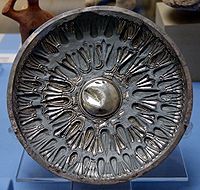
A phiale is the name given in modern terminology to a kind of ancient Greek ceramic or metallic vessel. Its form was that of a wide round shallow bowl without handles or a foot (a bowl with handles and a foot was a kylix), principally used for making libations (offerings of wine or oil).
Pileus
The pileus (Latin, plural, pilei) - also pilleus or pilleum - was a cap worn by sailors in Ancient Greece (where it was the pilos or pilidion) and later copied by Ancient Rome. It was a brimless, felt cap, somewhat similar to a fez. The pilleolus was a smaller version, similar to a skullcap.
Pistrix
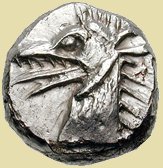
The sea-monster sent to devour Andromeda. In ancient art it is represented with a dragon's head, the neck and head of a beast, fins for the forelegs and the body and tail of a fish.
Alternate name is Ketos .
Plants
Apple - Is a symbol of Aphrodite.
Corn - Symbolized fertility, an attribute of Demeter.
Grapes - Symbol of Dionysos, God of Wine.
Ivy - Sacred to Dionysos who is often crowned with ivy.
Laurel - The tree sacred to Apollo, signifies peace.
Lily - The Greeks linked the lily with the queen of the gods, Hera.
Oak - The tree sacred to Zeus.
Pine - Pan and the "Tears of the Pine" and "Thyrsos"
Pomegranate - Symbol of fertility, emblem of Hera.
Poppy - Demeter's most important sacred plants were the poppy & mint, plus the grain crops.
Rose - The rose was associated with Aphrodite in Rhodes and Cyprus.
Vine - see grapes.
Some references courtesy of Wayne G. Sayles - Ancient Coin Collecting II.
Protome
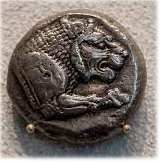
A Protome is generally understood to be the forepart of an animal, rarely for the bust of a human. The image shows a lion protome on a coin from Caria.
Prow
The prow is the forward most part of a ship's bow that cuts through the water. The prow is the part of the bow above the waterline. The terms prow and bow are often used interchangeably to describe the most forward part of a ship and its surrounding parts.
Pudenda Virilia
This Symbol is listed as describing the Male Sexual Organs. In the interests of modesty, I am merely listing an image of the coin.
In Ravel's "Les Poulains de Corinthe" he quotes "This symbol is undoubtedly apotropaic and, still nowadays, in certain regions of Greece, there is the superstition which these parts are strongly protective against the bad fate."
Quiver (Gorytos)
A quiver is a container for arrows. Quivers have been traditionally made of leather, bark, wood, furs and other natural materials. A gorytos designated in Antiquity a bow-case for a short recurve, or Scythian, bow. Usually, the gorytos would hold the full quiver with bow and arrows. Many gorytos were highly decorated.
Rhyton
A rhyton (plural rhytons or, following the Greek plural, rhyta) is a container from which fluids were intended to be drunk, or else poured in some ceremony such as libation. Rhytons were very common in ancient Persia, where they were called takuk.
After a Greek victory against Persia, much silver, gold, and other luxuries, including numerous rhytons, were brought to Athens. Persian rhytons were immediately imitated by Greek artists.
Sakkos
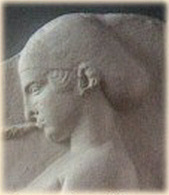
A type of cap called a Sakkos was worn by many Greek women, to cover their heads, from circa 500 B.C.E. Evidence of their head wear has been found on sculptures and in writings from the period.
The Sakkos could be a soft woven cap with a tassel hanging from the center or a piece of material wrapped around the head. In either case the Sakkos completely covered the hair, which was tied into a bun, except for the bangs or curls by the ears. Sometimes women wore a stephane, a metal upturned headband much like a tiara, as a decorative brim for their Sakkos.
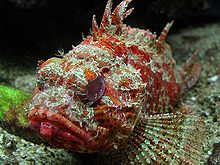
Scorpaena
Scorpaenidae, the scorpionfish, are a family of mostly marine fish that includes many of the world's most venomous species. As the name suggests, scorpionfish have a type of "sting" in the form of sharp spines coated with venomous mucus.
Silenus
The original Silenus resembled a folklore man of the forest with the ears of a horse and sometimes also the tail and legs of a horse. The later Sileni were drunken followers of Dionysus, usually bald and fat with thick lips and squat noses, and having the legs of a human. Later still, the plural "Sileni" went out of use and the only references were to one individual named Silenus, the teacher and faithful companion of the wine-god Dionysus.
A notorious consumer of wine, he was usually drunk and had to be supported by satyrs or carried by a donkey. Silenus was described as the oldest, wisest and most drunken of the followers of Dionysus.
Taenia
Taenia, fillet or wreath. Derived from the Ancient Greek tainia : "band" or "ribbon", taenia is the Latin word for a small "fillet" molding near the top of the architrave in a Doric column.
An ornament for the head, which the figure of Victory on coins often holds in her hand. This headband, the attribute of heroes, in the Homeric age became the coronal and diadem of a later period.
Tears of the Pine
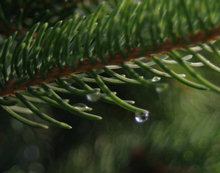
Pitys was a forest nymph so beautiful that she attracted both Pan and Boreas, the Wind of the North. When she had to decide, Pitys bestowed her favors upon Pan since Pan was making less noise; insulted and thirsty for revenge, Boreas tossed Pitys from a rock.
When Pan found the nymph unresponsive, he took pity on her and transformed her into his sacred tree, the pine tree. From then on, the nymph weeps every time the North Wind blows; her teardrops are the droplets of pine resin that dribble down each autumn of the year.
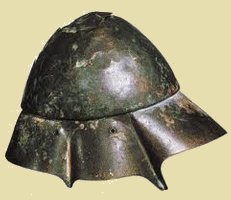
Thessalian Helmet
The Thessalian helmet was a type of helmet that was used in Classical Antiquity and the Hellenistic period and originated in Boeotia. It was an open helmet, allowing good peripheral vision and unimpaired hearing, and was therefore used primarily by the cavalry. Hence its use was not as widespread as other ancient helmets such as the Corinthian or Phrygian types.
Thunderbolt
An attribute and weapon of Zeus, his symbols are the thunderbolt, eagle, bull, and oak.
Zeus is frequently depicted by Greek artists in one of two poses: standing, striding forward, with a thunderbolt leveled in his raised right hand, or seated in majesty.
Thymiaterion
A thymiaterion is a type of censer or incense burner, formerly used in the Mediterranean region for spiritual and religious purposes and especially in religious ceremonies.
The term is used not only for the censers of ancient Greece, from where the term comes, but also to describe the censers of other peoples of the ancient world, such as the Phoenicians and Etruscans.
Thyrsos
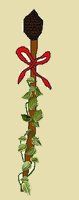
In Greek mythology, a thyrsus (thyrsos) was a staff of giant fennel (Ferula communis) covered with ivy vines and leaves, sometimes wound with taeniae and always topped with a pine cone.
These staffs were carried by Dionysus and his followers who were known as bacchantes.
Torch
A torch is a fire source, usually a rod-shaped piece of wood with a rag soaked in pitch and/or some other flammable material wrapped around one end.
The Torch is a symbol of the Greek goddess Demeter along with the Lion, Cornucopia & Sheaves of Wheat. The traditional use of the word lives on in the Olympic Torch, procession torches and the like.
Trident
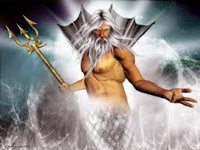
A trident, also called a leister or gig, is a three-pronged spear. It is used for spear fishing and was also a military weapon. Tridents are featured widely in mythical, historical and modern culture. The sea god Poseidon or Neptune is classically depicted bearing a trident.
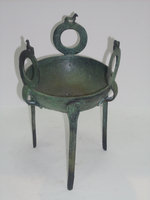
Tripod
Tripod is a word generally used to refer to a three-legged altar, generally one used as a platform of some sort, and comes from the Greek tripous, meaning "three feet". A symbol of Apollo.
Triskeles
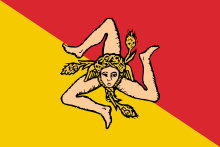
A triskelion is the symbol of Sicily where it is called trinacria (Flag of Sicily shown). The Manx and Sicilian triskelia feature three running legs, bent at the knee and conjoined at the hip area.
Triskelion or triskele is a motif consisting of three interlocked spirals, or three bent human legs, or any similar symbol with three protrusions and a threefold rotational symmetry.
No entries for U & V.
Wreath
A wreath is an assortment of flowers, leaves, fruits, twigs and/or various materials that are constructed to resemble a ring. Wreaths are usually made from evergreens and symbolize strength, as evergreens last even throughout the harshest winter. Bay laurel may also be used, and these wreaths are known as laurel wreaths.









 OR
OR