In William A. Mackay's famous research on King Alfred the Great's London Monogram coinage and its Danelaw imitations (British Numismatic Journal, volume 89, 2019, pages 19-107, hereafter "MacKay") he provides classification of all traceable first pennies and halfpennies issued by the Royal Mint in the name of King Alfred the Great, who united England and took London as its capital City in AD 886. All traceable Danelaw imitations of the said coinage were also classified in this paper. However, MacKay stated that there would be other coins from older collections that would later come to light. The London Monogram is a skillfully worked arrangement of the name Londonia designed by the Royal Mint's first moneyers in the IX century, and Londonia penny is very frequently shown to the visitors of the Royal Mint Museum.
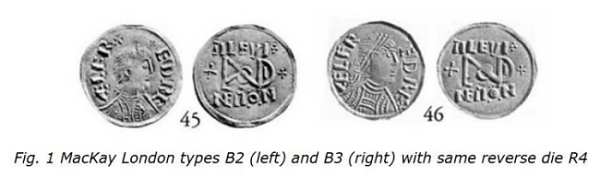
The London Type B2 penny has obverse showing King Alfred the Great's diademed bust in a neat tunic with concave shoulders (O2). On the reverse there is the London monogram and cross pattee on each side and the name of the moneyer – Tilevine above and below the monogram (R4). This type was known to Mackay from a single coin (MacKay B2 4 Pl. 3, 45) which first appeared on the market in 1918 at Sotheby's auction of the famous Carlyon-Britton collection. London Type B3 pennies are known in relatively large varieties, including the one with the same reverse R4 but a different portrait on the obverse – O3 (MacKay B3 5 Pl. 3, 46).
In his research on London type B coins (MacKay p. 40) Mackay established that the obverse die O2 of the London Type B2 was later replaced by the Royal Mint with the obverse die O3 of London Type B3, however the reverse die R4 survived the obverse transition, thus becoming a link between London types B2 and B3. This is illustrated on Fig.1
However, with great respect to MacKay's research, the following question still remained: was Type B2 obverse O2 used only with the "link" reverse R4? This question was difficult to answer, having only a single coin of this type imaged at the time of MacKay's writing. However, since obverse dies of hammered coins were known to age slower than reverse dies (as they were usually placed at the bottom of the structure and not struck directly with a hammer), it would be reasonable to think of other reverse dies, perhaps even totally previously unknown, which might have been used with the obverse O2.
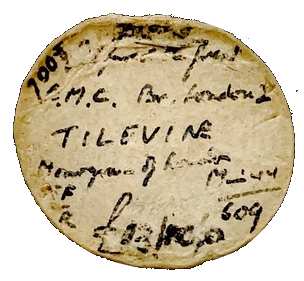
This was a mystery until November 2024 when Morton & Eden offered a previously unimaged Alfred the Great London monogram penny (fig. 2) in their auction 129 (lot 18) as a part of the famous Motcomb Collection of British Coins (part III), sold with the old Seaby ticket (Fig 3) dating back to 1944. This coin appears to be the second known of London B2 type with its reverse image unseen before November 2024. It was later graded AU 53 by NGC, which also shows high-resolution images.

This coin was described by Morton & Eden as of London type B2 (O2/R4var). Its reverse is similar to R4 however, instead of cross pattee on each side of the monogram, this has 4 pellets to the left and 7 pellets to the right, and the diagonal bar of the A is omitted.
So, the mystery is no longer a mystery and the answer to the London type B2 reverse variety question is definitely YES.
We researched on the provenance of this coin further and discovered the following:
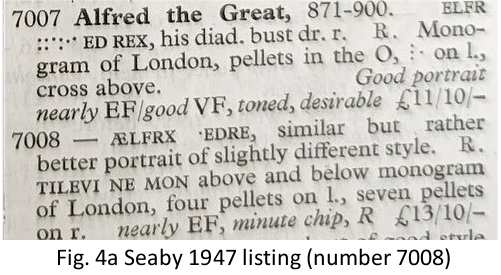
Mr. Steve Hill – a numismatic specialist and award winning author - found a description matching the old Seaby ticket in question in Seaby's Coin and Medal Bulletin No 349 (1947 vol., No 5), June 1947, page 239, inventory number 7008.
Seaby did not provide a photograph of this coin, but only the description shown on fig. 4a and the price of £13/10/-. (£13 10 shillings). The details of the listing fully match the
Seaby ticket on Fig.3 including the price, the Seaby inventory number and the World War II year during which it was acquired by Seaby. Unfortunately the Seaby records of that period have not survived and we might never know from which collection it came to Seaby back in 1944.
Possibly an even earlier publication of this coin was found by Mr. Leonard Augsburger in Seaby Coin and Medal List No 335 (1944 January-December), 3822 also without photo, and the description shown on fig. 4b priced at £12/10/-.
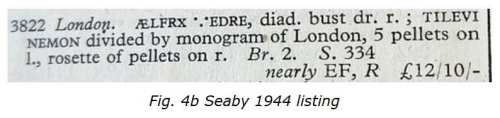
It is interesting that only the R2 reverse of London types B2 and B3 was known to show the moneyer's name Televine (sometimes referenced as Tilewine) interrupted above the monogram and continued below the monogram – TILEVI-NEMON. Also, only O2 is known to have a cross where the King's name is interrupted – ALFRX-EDRE. The newly photographed coin has both of those unique details as described in 1947 and 1944 listings and therefore we suspect that both Seaby publications possibly relate to the same coin in question. The prices shown in the 1944 and 1947 publications are different, however Seaby warned its customers in advance that the prices to be shown in their Standard Catalogue of the Coins of Great Britain and Ireland of 1947 will be higher than those in the catalogue of 1945 "owing to the large number of new collectors", which explains why the 1947 price of this coin was higher than it was in 1944.
Neither Seaby publications publish a photo of the coin, which explains why MacKay was unable to attribute this coin to any London Monogram type, despite having had access to those extremely rare Seaby publications.
It is amazing that this important coin – a piece of Anglo-Saxon history – had been sitting quietly in the famous Motcomb collection for 75 years until it was first published in the Morton and Eden catalogue less than 6 months ago and very recently its high resolution images appeared on NGC web site.
It is now an established fact therefore that London B2 pennies exist in 2 varieties – O2/R2 and previously unseen variety of O2/R2Var.
Still, MacKay's assertion, that the only known link between London types B2 and B3 is indeed the reverse die R2, remains correct as both dies, obverse O2 and reverse R2Var, appear to have been retired during the London type B2 period.
At the same time a new question can be asked: since the R4 var reverse die is not known to have survived the transition from London type B2 to type B3, was it used prior to the reverse die R4 which has survived the transition? Today, knowing only a pair of B2 type coins, we don't have an answer to this. Having a high resolution image of the obverse of MacKay B2 4 Pl. 3, 45 would certainly help to answer this question by assessing (with a certain degree of certainty) which one of the two coins' obverse die O2 was more worn, but we don't have access to such an image. It may become available in the future, or more coins will be found, and then the London type B2 research will continue.
I connected the author to Len Augsburger at the Newman Numismatic Portal. He found the material at the ANS library with the assistance of ANS chief librarian, David Hill. -ESylum Editor
Originally published April 6, 2025 in The E-Sylum, an electronic newsletter of the Numismatic bibliomania Society.